
Quantum Computing
Quantum Computing: Decoding the Fabric of Reality
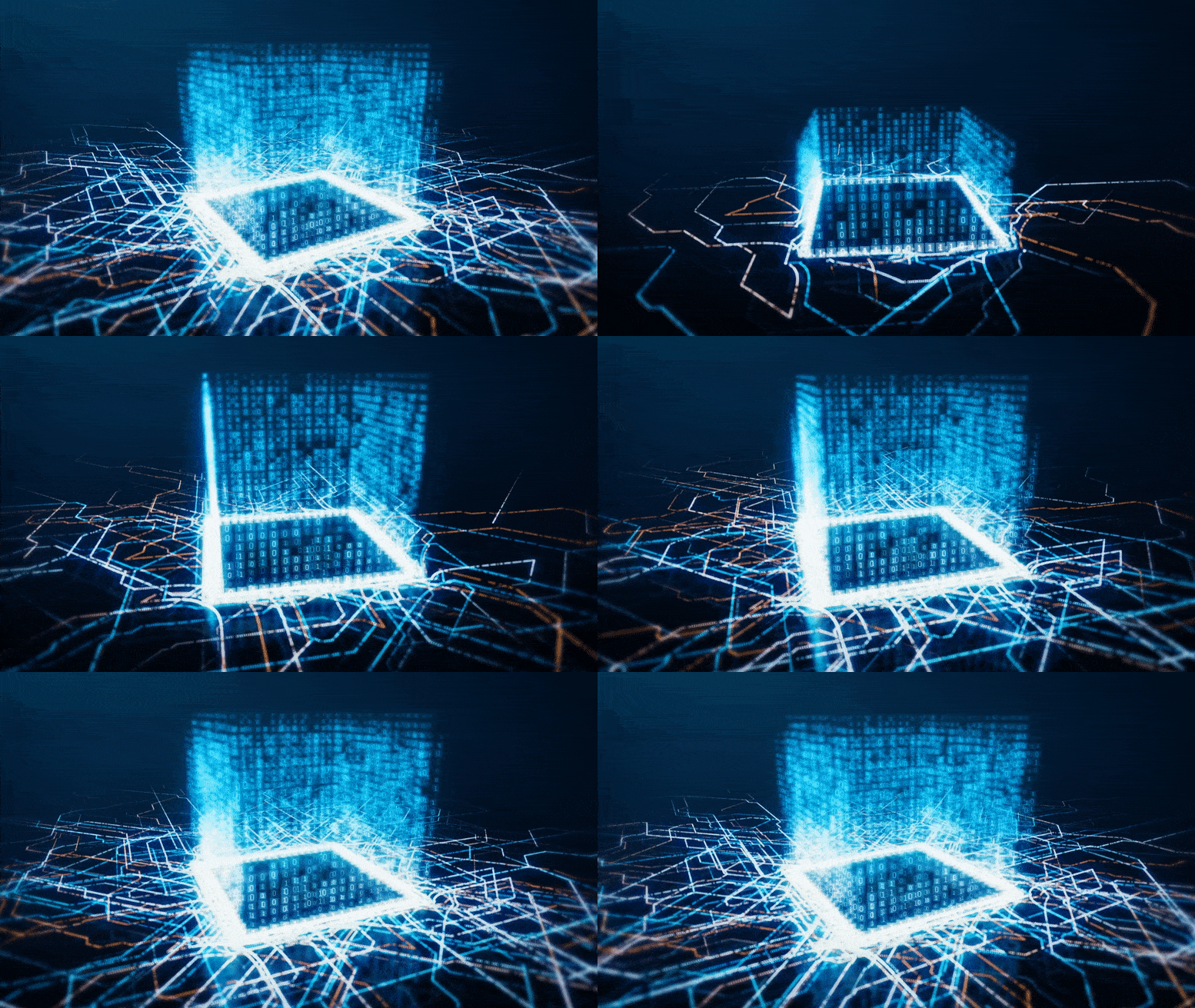
For decades, we have lived in a digital world defined by the binary: 0 or 1, true or false, on or off. But nature doesn't work in binaries. At the most fundamental level—the subatomic level—the universe is a swirling haze of probabilities and strange connections. Quantum Computing is our attempt to build machines that speak the true language of the universe.
Beyond the Binary: The Logic of the Very Small
In a classical computer, a "bit" is like a light switch—it’s either up or down. A quantum computer uses qubits, which operate on two mind-bending principles of physics:
Superposition: A qubit isn't just a 0 or a 1; it exists in a complex state of both simultaneously until it is measured. Imagine a spinning coin—while it's in the air, it’s neither heads nor tails, but a blur of both.
Entanglement: This is what Einstein called "spooky action at a distance." Two qubits can become linked so that the state of one instantly determines the state of the other, no matter how far apart they are.
This allows a quantum computer to map out a massive web of possibilities all at once, rather than checking them one by one.
Why This Changes Everything (Scientifically)
Shifting our perspective from "utility" to "discovery," quantum computing opens doors that have been locked since the dawn of modern science:
1. Simulating Nature Itself
Richard Feynman famously said, "Nature isn't classical, dammit, and if you want to make a simulation of nature, you'd better make it quantum mechanical." Classical computers struggle to simulate even simple molecules because the interactions are too complex. Quantum computers are built from the same "stuff" as those molecules, allowing us to model the universe with perfect fidelity.
2. The Search for Fundamental Patterns
In the vast noise of cosmic data or the intricate folding of proteins, there are patterns that are "mathematically invisible" to classical logic. Quantum algorithms can navigate these high-dimensional spaces, potentially revealing new laws of physics or the hidden geometry of biological life.
3. Cracking the Complexity Code
There are mathematical problems that are "hard" not because we aren't smart enough, but because the number of steps required to solve them exceeds the time left in the universe. Quantum interference allows these machines to "cancel out" wrong answers and amplify the correct ones, turning eons of calculation into minutes of processing.
A New Era of Understanding
We are currently in the "noisy" era of quantum development—building the first fragile bridges into this new reality. We aren't just building faster calculators; we are building new "eyes" to see the universe.
The transition from classical to quantum isn't just a technical upgrade—it's a philosophical shift. It’s a move from a world of certainties to a world of infinite possibilities, where the act of observation itself changes the outcome.
Curious about the intersection of physics and technology? Follow our series on the frontiers of human knowledge.
Comments (0)
No comments yet. Be the first!
Leave a Comment