
Agentic AI
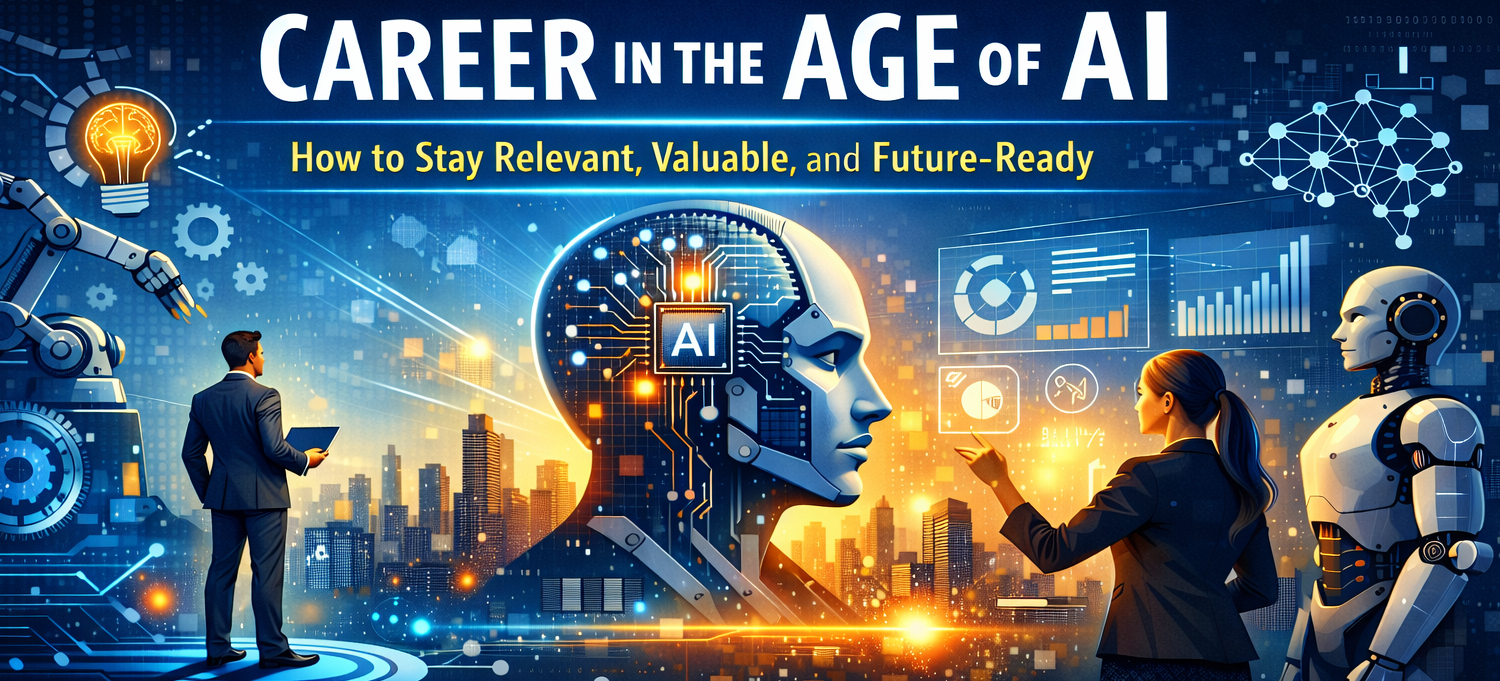
Career in the Age of AI: How to Stay Relevant, Valuable, and Future-Ready
The Age of Artificial Intelligence is no longer a distant future — it is here. From chatbots answering customer queries to AI systems generating code, analysing data, creating art, and even assisting in medical diagnoses, the transformation is happening across every industry. For professionals and students alike, one question keeps surfacing:
What does a stable, successful career look like in the Age of AI?
This is not just about job loss. It’s about job evolution, skill transformation, and redefining what makes humans valuable in a world where machines can think, analyze, and create.
Let’s explore what this new era means for careers — and how you can not just survive, but thrive.
The Shift: From Automation to Augmentation
Historically, technology replaced physical labor. The industrial revolution automated farming and manufacturing. Computers automated calculations and record-keeping.
AI is different.
AI automates cognitive tasks — writing, coding, analyzing, designing, diagnosing. Tasks once considered uniquely human are now partially automated.
But here’s the key distinction:
AI replaces tasks, not entire professions.
Most jobs consist of multiple tasks. Some tasks can be automated. Others require human judgment, creativity, empathy, or accountability.
The future of work is not humans vs AI. It is humans working with AI.
Jobs That Are Shrinking
Certain roles are more vulnerable because they rely heavily on repetition, rules, and digital workflows. Examples include:
Manual testing (QA)
Basic data entry
Routine bookkeeping
Tier-1 customer support
Entry-level content writing
Basic graphic design
Junior-level coding
These roles are not disappearing overnight, but they are being reshaped. Companies are reducing headcount where AI can perform 60–80% of the work faster and cheaper.
The warning sign is clear:
If your job is repetitive and rule-based, automation risk is high.
Jobs That Are Evolving
Some careers are not disappearing but transforming rapidly:
Business Analysts
AI can generate documentation and analyze data, but BAs must now focus on stakeholder alignment and strategic insight.
Developers
AI writes code, but developers are becoming system designers, reviewers, and problem definers.
Functional Consultants
Configuration and documentation are being automated, but transformation leadership is growing in importance.
Architects (Solution / Enterprise)
Diagram creation can be automated, but strategic trade-offs and executive influence remain human-led.
The pattern is simple:
Execution is automated. Decision-making becomes premium.
Jobs That Are Growing
While some roles shrink, others expand:
AI Engineers
Data Scientists
AI Governance & Ethics Specialists
Cybersecurity Experts
Cloud Architects
Robotics Engineers
Change Management Consultants
Digital Transformation Leaders
AI doesn’t just eliminate jobs — it creates new ecosystems.
But not everyone needs to become an AI engineer. In fact, the biggest opportunity lies in AI-enabled professionals — people who use AI to multiply their productivity.
The New Career Formula
Success in the Age of AI depends on five core pillars.
1. Human Skills Are the New Premium
Empathy. Leadership. Negotiation. Communication. Ethical judgment.
AI lacks emotional intelligence and accountability. The more your role depends on influencing people and making high-stakes decisions, the safer you are.
Soft skills are becoming hard currency.
2. Strategic Thinking Beats Task Execution
AI can execute tasks. Humans must define direction.
The professional who asks:
What problem are we solving?
What trade-offs matter?
What risks are acceptable?
What long-term impact does this have?
… will remain valuable.
Strategic roles are rising in importance across industries.
3. Technical Literacy Is Mandatory
Even non-technical professionals must understand:
How AI works at a basic level
Its limitations and biases
Where automation applies
How to prompt effectively
How to validate AI outputs
You don’t need to code deep neural networks, but you must understand the tool.
The new illiteracy is not ignorance of reading and writing — it is ignorance of AI.
Comments (0)
No comments yet. Be the first!
Leave a Comment